


Introduction
Decarbonization efforts often focus on large industrial complexes, leaving small and mobile emitters without viable carbon capture solutions. This case study explores the development of a compact, cost-effective, MEA-based carbon capture prototype designed to operate on small exhaust streams. Built through an innovation challenge on “Modeling and Analysis of the Carbon Capture Process,” the prototype successfully demonstrated meaningful CO₂ capture performance in a simple, real-world setup.
The proof-of-concept highlights the potential for affordable and retrofit-friendly carbon capture systems that can support small industrial, commercial, and mobile sources, which are often overlooked by conventional carbon capture technologies. Commercial development of the prototype would require further testing and validation.
Industry context & problem statement
Industries generating CO₂ from small boilers, generators, engines, and distributed assets face a unique challenge. Conventional post-combustion carbon capture systems are engineered for large emitters, demand substantial capital investment, and require continuous high-volume flue gas streams. This leaves a critical gap for small or transient sources where decarbonization is equally important but technologically inaccessible.
Emerging climate strategies require the development of compact, modular, and low-cost CO₂ capture systems. The innovation challenge aimed to address this gap by exploring whether a simple, low-cost, solvent-based prototype could demonstrate meaningful CO₂ reduction.
Solution approach
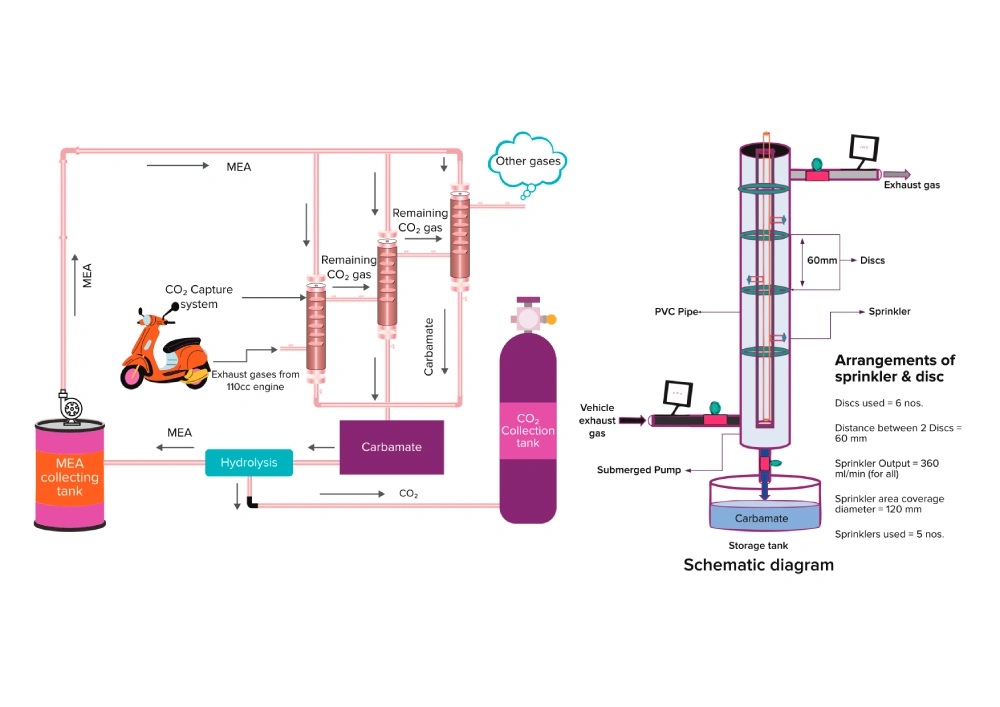
The team designed and built a bench-scale post-combustion CO₂ capture prototype using the well-established chemistry of MEA-based solvent.
Key design features
- Compact reaction chamber: Developed using a low-cost PVC structure to validate the concept quickly.
- Spray/disc contactor: A sprinkler-style arrangement created fine droplets of MEA to maximize gas–liquid contact.
- Real exhaust gas source: The system operated using the exhaust from a 110 cc scooter engine, representing a small, variable, difficult-to-capture stream.
- Real-time CO₂ monitoring: CO₂ concentration was continuously measured using a sensor and streamed via a Blynk app for live visualization and data capture.
- Scalable architecture concept: The prototype evaluated the potential of multi-chamber series configurations to achieve higher capture efficiency.
Key facts
- Prototype based on post-combustion CO₂ absorption using MEA-based solvent
- Tested with real engine exhaust, not synthetic gas
- Achieved ~59% capture in a closed setup using 350 mL MEA
- Delivered ~35% capture in an open 4-minute run under variable flow
- Enabled remote, real-time CO₂ monitoring through IoT connectivity
- Identified clear engineering pathways for scale-up and refinement
Results & observations
Performance highlights
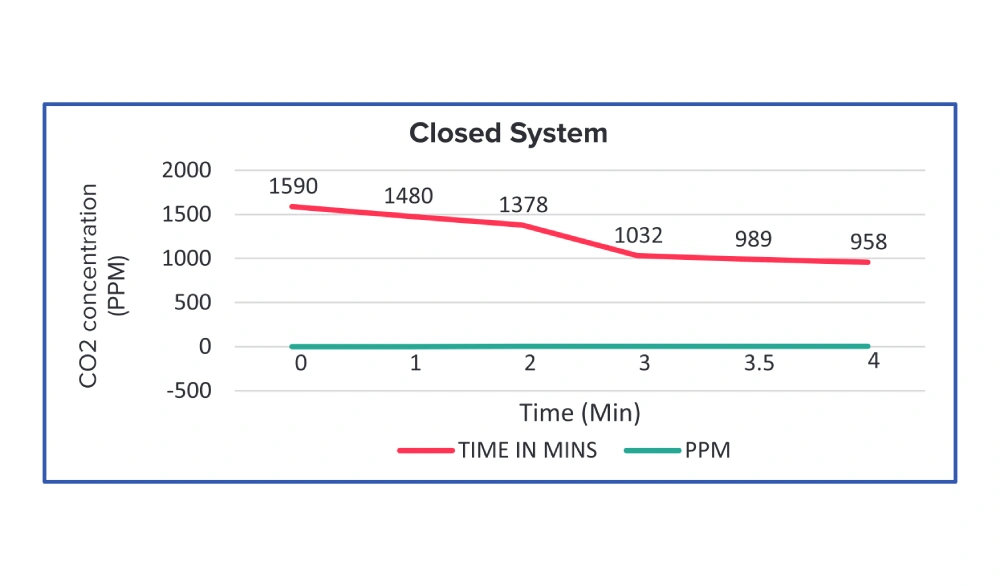
- Closed-system performance:
The prototype achieved approximately 59% CO₂ capture using 350 mL of MEA. This validated that a simple spray-based absorber can deliver meaningful absorption efficiency, even in a basic environment.
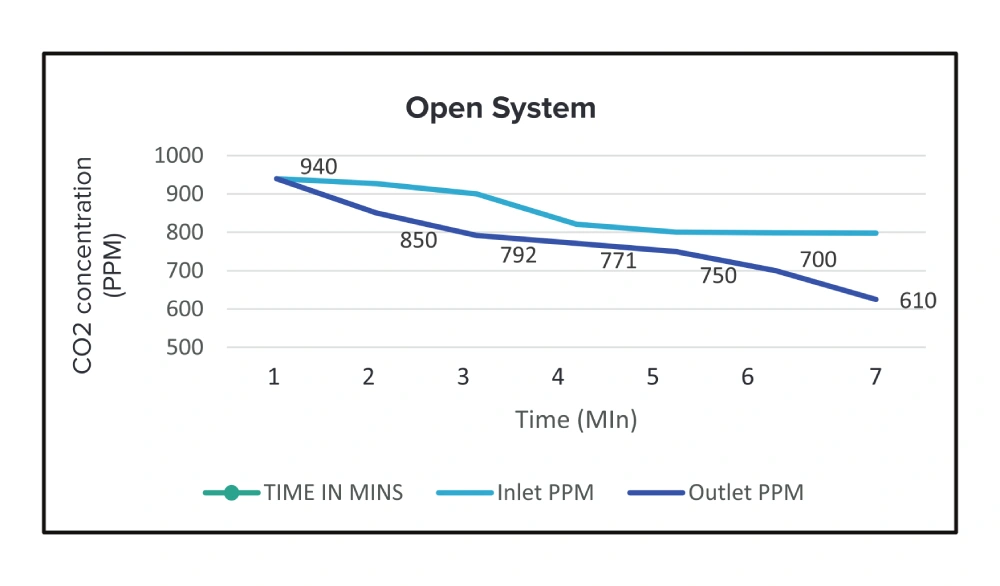
- Open-system performance:
A short-duration, open-system test delivered roughly 35% capture over four minutes, limited by airflow variability and gas leakage inherent in open configurations.
Operational insights
- Exhaust temperature influenced PVC structural stability, reinforcing the need for industrial-grade materials.
- Sensor calibration and placement significantly impacted measurement accuracy.
- MEA performance was strong in the first cycle, but long-term degradation and regeneration pathways require further study.
Lessons learned
- Material suitability is critical: PVC is effective for rapid prototyping but unsuitable for long-term or high-temperature use.
- Gas tightness drives efficiency: Leakage pathways can significantly reduce capture performance.
- Sensor positioning & calibration matter: Minor shifts in sensor location affect CO₂ readings and efficiency calculations.
- Regeneration is essential for viability: Without a solvent recovery pathway, operational cost and environmental impact increase.
- Flow control improves reliability: Consistent gas and liquid flow rates are required to stabilize efficiency in open systems.
Business & sustainability impact
Although at the proof-of-concept stage, the prototype demonstrates strategic promise:
- Unlocks carbon capture for underserved segments: Small emitters, mobile systems, and distributed industrial assets.
- Reduces adoption barriers: Low-cost components and simple engineering lower the entry threshold.
- Supports modular deployment: Multi-chamber concepts allow scalability without large infrastructure.
- Enables remote monitoring: IoT-based telemetry supports operational visibility, diagnostics, and predictive maintenance.
This approach offers organizations a future pathway to adopt carbon capture technologies without major capital investment or operational disruption. The model’s commercial feasibility has to be assessed as part of future development work.
Engineering roadmap for scale-up
To progress from a prototype to a pilot-ready solution, several technical advancements are required:
Engineering priorities
- Material upgrade: Transition from PVC to stainless steel or other industrial-grade materials capable of handling exhaust temperatures and corrosion.
- Solvent regeneration: Develop a practical MEA regeneration process to reduce solvent consumption and improve lifecycle sustainability.
- Closed-loop system design: Integrate pumps, flow controllers, and enhanced sealing to improve reliability.
- Durability testing: Conduct corrosion, MEA degradation, and long-duration operational testing.
- Scale-up & modularization: Design multi-chamber or stacked units to handle increased gas flow.
- Techno-economic evaluation: Establish cost per ton of CO₂ captured, solvent cycle economics, and operational overhead.
Preparing for scale-up
- Develop a digital twin to simulate absorber performance and guide scale-up.
- Upgrade absorber construction to industrial-grade materials
- Design a regeneration subsystem for MEA reuse
- Implement flow-controlled gas and liquid circulation
- Conduct extended durability and safety testing
- Build a pilot-scale, modular absorber for real industrial flue gas
- Perform TEA and LCA assessments to quantify viability
Acknowledgments
This prototype was developed through collaborative effort by the Quest Global innovation team:
Arjun G (Project Leader), Santosh Chittaragi, (Lead Engineer), Kiran Bhagavati, Libin Antony (Senior Engineers),Venkatesh Sonnad, Amogh Kulkarni (Engineers)